









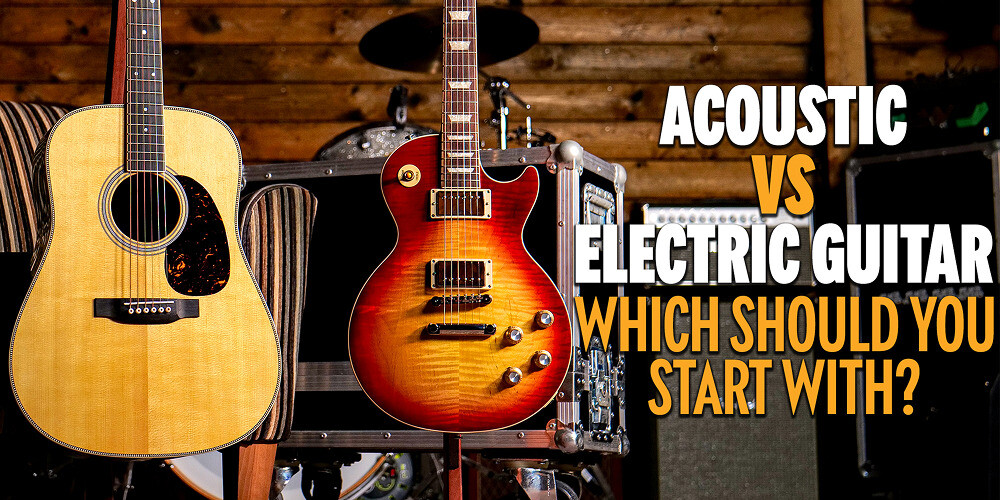
Acoustic vs Electric Guitar: Which Should You Start With?
Choosing your first starter guitar is one of the most important decisions you will make as a new player. One of the first questions that comes up is whether to begin with an acoustic or an electric guitar.
There is no single correct answer. Both options have their strengths, and the right choice depends on your goals, the music you enjoy and what feels comfortable in your hands.
This guide breaks down the real differences between acoustic and electric guitars and helps you decide which is the better fit for your starting point.

What is the main difference between acoustic and electric guitars?
At a basic level, the difference comes down to how the sound is produced.
An acoustic guitar creates sound naturally through its hollow body. You can pick it up and play without any additional equipment.
An electric guitar relies on pickups and an amplifier to produce sound. This gives you more control over tone, but it also means you need extra gear.
Both approaches have their advantages, and neither is inherently better for a guitar for beginner players.
Playability and comfort
One of the biggest differences for beginners is how the guitar feels to play.
Electric guitars are generally easier on the fingers. They use lighter strings and typically have a slimmer neck, which makes pressing down notes and bending strings more comfortable.
Acoustic guitars often have thicker strings and slightly higher tension. This can make them feel more challenging at first, especially for complete beginners.
If comfort is your priority, many players find starting on an electric guitar makes the early stages smoother.

Sound and volume
Acoustic guitars are naturally louder. They project sound without the need for amplification, which makes them convenient for practice and casual playing.
Electric guitars are much quieter when unplugged. To get the full sound, you will need an amp. This allows you to control volume more easily, which can be useful if you are practising at home.
Your environment can influence your choice. If you need something simple and self-contained, an acoustic guitar may appeal. If you want volume control and flexibility, electric may suit you better.
Versatility and tone
Electric guitars offer a much wider range of tones. With the help of an amplifier and effects, you can shape your sound in many different ways.
This makes them ideal for genres like rock, metal, blues and pop. Brands such as Fender, Gibson, Ibanez, PRS and Yamaha all offer beginner-friendly options with different tonal characteristics.
Acoustic guitars have a more natural and consistent sound. They are well suited to singer-songwriter styles, folk and stripped-back arrangements.
If you want tonal variety and experimentation, electric guitars have the edge. If you prefer simplicity and a classic sound, acoustic guitars are a strong choice.
Learning and technique
There is a common belief that you should start on an acoustic guitar to build strength and technique. While there is some truth to this, it is not essential.
What matters more is consistency. You are more likely to practise regularly if your guitar feels comfortable and enjoyable to play.
An electric guitar can make learning less physically demanding in the early stages. An acoustic guitar can help build finger strength over time.
Both will teach you the same fundamental skills, so your choice should reflect what keeps you motivated.

Cost and equipment
Acoustic guitars are often seen as the simpler option because they do not require additional equipment.
With an electric guitar, you will need an amp and a cable at minimum. This adds to the initial cost, but it also gives you more flexibility in shaping your sound.
Starter setups are available for both types, and there are quality options at a range of price points. Whether you choose an electric guitar or an acoustic guitar, it is worth focusing on build quality and playability rather than just price.
Which is better for a beginner?
The best guitar for beginner players is the one that suits their goals and encourages regular practice.
You may prefer an electric guitar if you want easier playability, more tonal variety and the ability to explore different sounds as you learn.
You may prefer an acoustic guitar if you want a simple, all-in-one instrument that is ready to play at any time.
There is no wrong choice. Many players eventually use both.
Trying both options, even briefly, can help you understand what feels right. Comfort, sound and inspiration should guide your decision more than anything else.